Hip Abduction Machine - Should You Lean Forward? or Backward?
Updated: Sep 5
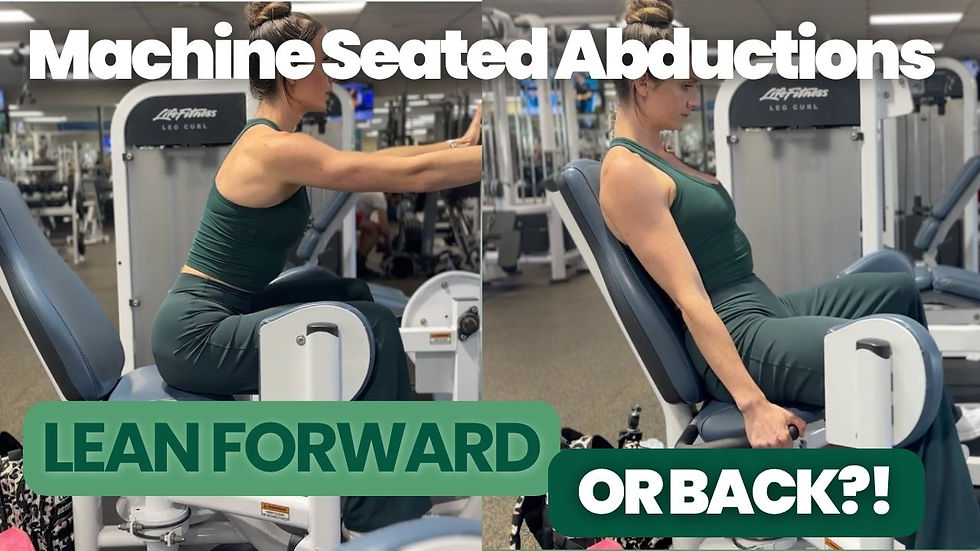
You’ve probably seen people leaning all the way forward, while others sit tall against the pad… and maybe you’re wondering, which one is actually right?
This is one of the most common questions I hear from clients.
The truth is, both positions are correct. The difference lies in which part of the glutes you emphasize and how you execute each rep. Let’s break it down.
What muscles does leaning forward on the hip abduction machine target?
The hip abduction machine primarily works the muscles that move your leg out to the side:

Gluteus medius and gluteus minimus — often referred to as the “side glutes,” these muscles work to provide hip abduction and pelvic stability. They help control hip alignment during walking, running, and lateral movements.
Gluteus maximus — the largest glute muscle, responsible for hip extension, stability, and much of the overall shape and fullness of the glutes.
Both positions will the glute medius, glute minimus, and the upper fibers of the glute max. What changes is the emphasis based on your setup.
You’re never turning one muscle “off” and the other “on.” What changes is how much emphasis each muscle group gets based on your setup.
You can shift a little more of the tension onto different parts of the glute by changing your setup/execution.
You Can’t “Turn Off” a Muscle
One of the biggest misconceptions in training is the idea that an exercise can completely isolate a single muscle while “turning off” the others. In reality, your body doesn’t work that way.
Every movement is the result of multiple muscles working together. On the hip abduction machine, whether you lean forward or sit upright, your glute med, glute min, and glute max are all active to some degree. What changes is the relative contribution of each muscle depending on your body position.
👉 Think of it as a sliding scale.
Leaning forward shifts more work toward the glute max while the glute med and min still assist.
Sitting upright shifts more work toward the glute med and min while the glute max still stabilizes and contributes.
This is what we mean by biasing a muscle: you can place greater emphasis on one area, but you cannot fully switch another one off.
Why This Matters for Training
Set realistic expectations. No single exercise or position will magically “hit only the side booty” or “only the glute max.” Both are working together, just with different levels of emphasis.
So, you're never turning one muscle off and another on. All of these muscles are working. What changes is the emphasis based on your torso position.
Sitting Upright / Leaning Back on the Hip Abduction Machine
When you sit tall with your back against the pad, your hips stay in a more neutral position.
Bias: Glute med and min
What you feel: More tension in the outer glutes and less contribution from the glute max.

These muscles work to provide pelvic stability and functional movement. Strengthening them reduces the risk of hip and lower back issues and improves balance in compound lifts like squats and lunges.
This position is biased for targeting more of the “side booty”
Leaning Forward on the Hip Abduction Machine
Leaning forward places your hips into more flexion, which shifts the emphasis.
Bias: Glute max (especially upper fibers)
What you feel: A stronger contraction through the meaty part of the glutes. But the glute med and min are still very much engaged.

The glute max is the powerhouse muscle of your glutes, responsible for hip extension and adding fullness to your physique. It’s also a major stabilizer in athletic movements.
This position is biased for targeting more of large, meaty part of the posterior glute.
Is Leaning Forward Better for Your Glutes?
The honest answer is, Not automatically.
Execution Matters More Than Position. Leaning forward can change where you feel the exercise, but it is not a secret shortcut to better glute growth. If your torso is rocking, your range is getting shorter, or you are throwing the weight open just to move a heavier stack, the position matters a lot less.
Whether you lean forward or sit upright, the way you perform each rep is what truly drives growth.
Common mistakes include using too much weight, swinging the torso, and letting the weight stack slam.
The goal is to create as much controlled tension through the glutes as possible.
That means:
✅ Sit tall with your rib cage stacked over your pelvis
✅ Brace your core to keep your torso stable
✅ Drive your knees out into the pads (not your feet)
✅ Pause at the top for 1–2 seconds
✅ Control the return slowly without letting the stack rest
Growth comes from controlled, intentional reps that keep tension on the glutes, not momentum or compensating with surrounding muscles.
Should you lean forward on the hip abduction machine? The Bottom Line
Here’s the part that gets lost when people argue about the “best” way to sit on this machine:
Changing your torso position changes the exercise, but it does not magically turn one glute muscle on and the others off.
It’s not a question of which position is better. Both leaning forward and sitting upright have value, and together they provide a more complete approach to glute development.
Sit upright to strengthen the glute med/min and improve hip stability.
Lean forward to recruit more glute max for size and fullness.
If your goal is more complete glute development, you do not need to marry one version forever. You can:
✅ Use the upright variation to emphasize the glute medius and minimus
✅ Use a slight forward lean to get more contribution from the upper glute max
✅ Rotate between the two across different training phases
✅ Keep whichever variation you can feel, control, and get stronger in over time
If you don’t want to spend your workouts wondering whether your setup, exercise selection, or progression actually makes sense, coaching can make it easy!
I offer custom 1:1 coaching plans tailored to your goals, or a budget-friendly group coaching program that gives you structure, accountability, and support and removes all of the guesswork.
Both options are designed to help you build a strong, confident body in a way that’s sustainable and enjoyable!